Chair Lifts for Stairs with Landings: Curved, Split & Transfer Options
Staircases with landings require a different stairlift approach than straight stairs. Here are the three configurations, realistic costs, and the best models for each.

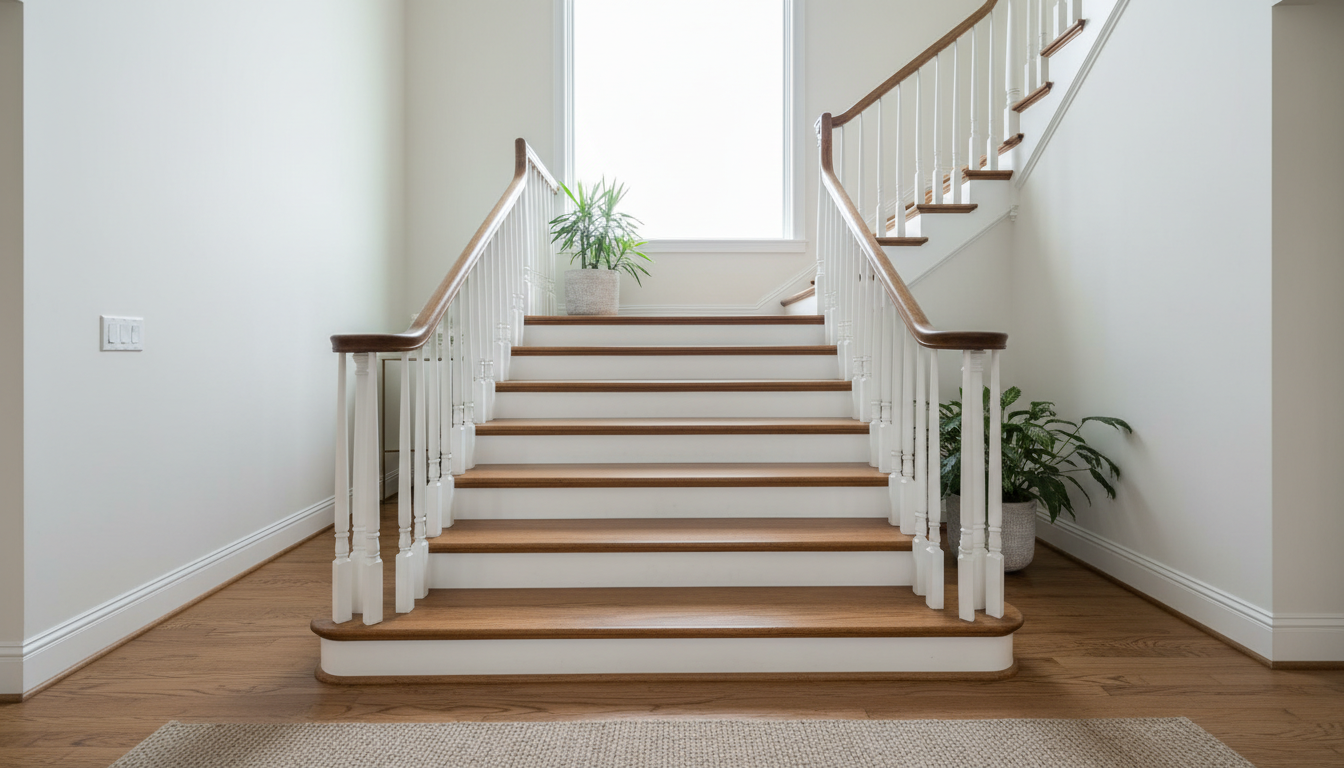
Why Stair Landings Complicate Stairlift Installation
A straight staircase is the easiest and cheapest layout for a stairlift — a single straight rail bolts to the treads, and any major brand can install it in a few hours. The moment a landing enters the picture, everything changes. Landings introduce direction changes, varying step heights, and transition zones that a standard straight rail simply cannot navigate.
Most American homes built after 1950 include at least one landing somewhere in the stairway — often at a 90-degree turn between the first and second floor, or a 180-degree switchback in narrower two-story homes. Multi-story homes, split-level layouts, and older Victorian-style houses frequently feature multiple landings on a single run. For seniors who need a chair lift on these staircases, the configuration options, costs, and installation timelines are all significantly different from a basic straight stairlift.
The good news is that modern chair lift technology handles landings well. You have three distinct solutions to choose from, and the right pick depends on your staircase geometry, budget, and how much the user can transfer between seats.
Three Configuration Options for Stairs with Landings
When a chair lift needs to navigate a staircase with one or more landings, installers generally recommend one of three approaches:
- Curved rail stairlift — A single continuous custom-bent rail that follows the entire staircase including the landing turn. The chair travels in one smooth motion from top to bottom.
- Two straight stairlifts with transfer — Two separate straight-rail lifts installed on each flight, with the user transferring seats on the landing.
- Straight stairlift with park-at-landing configuration — A hybrid approach used when only one flight has a lift and the other is walked with a handrail or cane.
Each option has tradeoffs in cost, installation complexity, user experience, and resale value. The table below summarizes the key differences.
| Configuration | Best For | Typical Cost | Install Time | User Transfer Required |
|---|---|---|---|---|
| Curved rail (custom) | Users with limited mobility who cannot safely transfer | $9,000 – $18,000 | 4–8 weeks lead time, 1 day install | No |
| Two straight stairlifts | Users who can safely stand and walk a few steps on the landing | $5,000 – $8,000 combined | 1–2 weeks, same-day install | Yes — transfer between seats |
| Single straight + handrail | Homes where one flight is rarely used or fully accessible | $2,500 – $4,500 | 1 week, same-day install | Partial — walk one flight |
Curved Rail Stairlifts: The Seamless Solution
A curved rail chair lift is the gold standard for staircases with landings. The rail is custom fabricated to match the exact geometry of your stairs — including the landing turn, any intermediate bends, and the top and bottom parking positions. The chair glides in one continuous motion, rotating smoothly around the landing without stopping or requiring the user to transfer.
For seniors with significant mobility impairment, dementia, or balance concerns, a curved rail is often the only safe option. The user sits down once at the top, rides the entire staircase, and steps off once at the bottom. There is no mid-ride transfer to negotiate, which eliminates a common fall risk point.
How the custom process works:
- A technician performs an on-site measurement using digital photogrammetry or laser measuring tools to capture exact staircase dimensions and angles.
- Measurements are sent to the manufacturer — typically Stannah in the UK, Bruno in Wisconsin, or Handicare in Sweden — where the rail is bent to spec.
- Lead time for rail fabrication is usually four to eight weeks, though premium brands like Stannah offer expedited two-week fabrication at additional cost.
- Final installation on-site takes one full day with two technicians.
The downside of curved rails is cost. Expect to pay $9,000 to $18,000 for a residential curved stairlift depending on the rail length, number of turns, and brand. This is roughly two to four times the cost of a straight stairlift of similar length. For families comparing options, our complete stair lift buying guide covers budget ranges across all major configurations.
Two Straight Stairlifts with a Transfer Seat
For homes where the senior can safely stand, pivot, and walk two or three steps independently, installing two separate straight stairlifts — one on each flight — is a budget-friendly alternative to a curved rail. The user rides the first stairlift up to the landing, stands and walks across the landing, then sits on the second stairlift to continue to the next floor.
This configuration typically costs $5,000 to $8,000 combined for both units — a savings of $4,000 to $10,000 compared to a curved rail. Installation is also much faster, usually completed in a single day once both lifts are on site, with no custom fabrication lead time.
When the two-straight configuration works well:
- The user has reliable standing balance and can walk a few steps with a cane or walker.
- The landing is large enough (at least 36 by 36 inches of clear space) for safe transfer.
- A grab bar or handrail can be installed on the landing wall for additional support during transfer.
- Budget is a significant constraint.
When it does not work:
- The user has dementia, Parkinson’s, or severe balance issues that make transfer risky.
- The landing is small (less than 32 inches deep) or irregularly shaped.
- The user uses a wheelchair exclusively and cannot safely pivot standing.
If the two-straight approach is not right for your situation, it is worth also reviewing alternatives to stair lifts like residential elevators or platform lifts.
90-Degree vs 180-Degree Landing Layouts
The geometry of your landing dictates which configurations are feasible and how much a curved rail will cost. The two most common residential layouts are the 90-degree quarter-turn and the 180-degree half-turn.
90-Degree (Quarter-Turn) Landings
A 90-degree landing is the most common layout in modern American homes. Stairs rise in one direction, hit a landing, then turn 90 degrees and continue up. The total change in direction is one right angle.
For curved rail lifts, 90-degree landings are the simplest and most affordable curve to fabricate. Expect curved rail costs in the $9,000 to $13,000 range for a standard two-flight residential staircase with a single 90-degree turn. The chair rotates smoothly through the turn without the user needing to do anything.
180-Degree (Switchback or Half-Turn) Landings
A 180-degree landing reverses the direction of the staircase completely. This layout is common in narrow urban townhouses, older colonial homes, and apartments where floor space is at a premium. Stairs go up, hit a landing, then turn completely around and continue up in the opposite direction.
180-degree landings require more complex rail bending and typically cost $12,000 to $18,000 for a curved rail installation. The chair also rotates more significantly during the turn, which some users find disorienting the first few rides. Most people adjust within a week of daily use.
Multiple Landings and Winders
Some homes feature three or more landings (split-level and multi-story), or use winder stairs — pie-shaped wedge steps that curve around a corner without a flat landing. Both configurations are still manageable with modern curved rail technology, but the rail cost climbs with each additional turn. A three-flight staircase with two 90-degree landings can run $15,000 to $22,000 for a curved chair lift.
Cost Comparison: Curved vs Split Installations
The table below breaks down total installed cost for a typical two-story residential staircase with a single landing, including the lift, rail, installation labor, and standard warranty.
| Configuration | Equipment | Labor & Install | Total Installed | Warranty Included |
|---|---|---|---|---|
| Curved rail (90-degree) | $8,500 – $12,000 | $500 – $1,000 | $9,000 – $13,000 | 2–5 years |
| Curved rail (180-degree) | $11,000 – $16,500 | $1,000 – $1,500 | $12,000 – $18,000 | 2–5 years |
| Two straight lifts | $4,500 – $7,000 | $500 – $1,000 | $5,000 – $8,000 | 1–3 years each |
| Single straight + handrail | $2,200 – $4,000 | $300 – $500 | $2,500 – $4,500 | 1–3 years |
Used and reconditioned curved rail stairlifts do exist, but the used market is small because rails are custom-fabricated to a specific staircase. A used rail rarely fits a different home without significant re-fabrication, which negates most of the cost savings. Reconditioned chairs paired with a newly bent rail can sometimes save 20 to 30 percent off retail.
Best Chair Lift Models for Staircases with Landings
For homes with landings, not every stairlift brand is equally capable. Some manufacturers specialize in curved rails and have decades of experience with complex geometries; others focus on straight-rail residential models and outsource curved fabrication.
Stannah Siena 260 Curved (best overall). Stannah is the oldest and largest curved stairlift manufacturer in the world, with more than 150 years of experience. The Siena 260 is their flagship curved residential model, offering the smoothest landing navigation, a powered swivel seat that turns 90 degrees at the top landing for safe dismount, and a 2-year comprehensive warranty. Expect $12,000 to $18,000 installed for a typical two-flight staircase with a 90-degree landing.
Bruno Elite CRE-2110 (best American-made). Bruno manufactures its curved rails in Oconomowoc, Wisconsin, offering faster lead times than imported brands (3–5 weeks versus 6–8 weeks for European brands). The Elite CRE-2110 handles up to 400-pound weight capacity and includes a 5-year rail warranty — the longest in the industry. Our breakdown of the most reliable stairlift models for multi-story homes ranks the Bruno Elite near the top for multi-flight reliability.
Handicare Freecurve (best for tight spaces). The Handicare Freecurve uses a single-tube rail design that sits closer to the wall than dual-rail systems, making it ideal for narrow staircases and tight landings common in older homes and urban townhouses. The slim profile rail costs slightly more than competitors but preserves walking clearance for other family members.
Acorn 180 (budget curved option). Acorn’s curved rail is the most affordable option on the market at $7,500 to $11,000 installed for a 90-degree configuration. The tradeoff is a shorter 1-year comprehensive warranty and slower lead time (8–10 weeks for rail fabrication). For families on a tight budget who need a curved solution, Acorn is a legitimate choice.
Harmar Pinnacle SL600 (for the two-straight approach). If you are installing two separate straight stairlifts on either side of a landing, the Harmar Pinnacle SL600 is a strong pick for each flight. It has a compact folding footprint that leaves the landing clear for transfers, a 350-pound weight capacity, and a typical installed cost of $2,400 to $3,200 per unit.
How to Plan Your Chair Lift Installation
Once you have decided on a configuration, the installation process itself has several important steps that determine whether the final lift works reliably for years or develops problems in the first few months.
Step 1: Schedule an in-home assessment. Every reputable stairlift dealer offers free in-home consultations. The technician measures the staircase, identifies electrical outlet locations, checks for trim or moulding that might interfere with the rail, and discusses the user’s specific mobility needs. For curved rails, this visit is where precise digital measurements are captured for the fabrication team.
Step 2: Confirm electrical requirements. Chair lifts run on standard 120V household current through a dedicated outlet at each parking position. For two-straight configurations, you will need outlets at both the top and bottom of each flight — potentially four outlets total. If outlets are not conveniently located, budget $150 to $300 per outlet for an electrician to add them before installation day.
Step 3: Prepare the staircase. Remove any runners, rugs, or trim pieces that will be in the rail’s path. The rail bolts directly to the treads, not the wall, so the condition of your stair treads matters — loose or damaged treads should be repaired before installation.
Step 4: Installation day. Straight stairlift installation takes two to four hours per unit. Curved rail installation takes a full day (six to eight hours). The installer will test the lift through its full range of motion, walk the primary user through controls, and explain battery care and maintenance.
Step 5: Plan for maintenance. Chair lifts need annual service visits to check battery condition, lubricate the rail, and inspect safety sensors. Budget $150 to $300 per year for routine maintenance. Our guide on what to expect during stair lift installation walks through the full process in detail.
Choosing the Right Solution for Your Home
For most families dealing with a staircase that has a landing, the decision comes down to three questions: Can the user safely transfer between seats? How long do you expect to need the lift? And what is your total budget?
If the user has significant mobility limitations, cognitive impairment, or balance concerns, a curved rail is worth the additional investment. The smooth one-ride experience eliminates the most common fall risk point in a multi-flight stairlift setup — the mid-ride transfer.
If the user is reasonably mobile, has good balance, and can walk a few steps with assistance, the two-straight configuration offers substantial savings with minimal compromise. Many families successfully use this approach for five to ten years before mobility changes require a switch to a curved rail.
Regardless of the configuration you choose, pairing the lift with other home safety upgrades — fall prevention strategies, proper lighting on the stairs and landing, and a professional home safety assessment — creates the safest possible environment for aging in place.
Ready to get accurate pricing for your specific staircase? Schedule a free in-home assessment and we will measure your stairs, evaluate both curved and split configurations, and give you firm quotes from the top three manufacturers best suited to your home.
Need Help Choosing a Stairlift?
Our free in-home assessment covers your staircase measurements, power situation, and budget to find the perfect fit.
Explore Stair Lifts
About James Wilson
Home Safety Specialist & Accessibility Consultant
Certified home safety specialist with 10+ years designing accessible living spaces for seniors and individuals with mobility challenges.